Thursday, 7 August 2014

Use of English - Rephrasing #004 (CAE)

There is no upper and lower limit in the number of words here. Answers are in white below its respective sentences. Highlight them to be able to read them.

25. She said she would lend me her notes.
promised
She                                me her notes.
She promised to lend me her notes.

26. Although she studied very hard, she didn’t do very well in the exam.
despite
She didn’t do very well in the exam                            very hard.
She didn’t do very well in the exam despite studying very hard.

27. My father often played the piano while we sang.
used
My father                                     while we sang.
My father used to play the piano while we sang.

28. If I don’t feel better tomorrow, I’ll go to the doctor.
unless
I’ll go to the doctor tomorrow                     better.
I’ll go to the doctor tomorrow unless I feel better.

29. You mustn’t talk during the test.
supposed
You                                        during the test.
You are not supposed to talk during the test.

30. I couldn’t tolerate her bad behaviour any longer.
put
I couldn’t                    her bad behaviour any longer.
I couldn’t put up with her bad behaviour any longer.

31. I have a degree and also extensive sales experience.
addition
I have extensive sales experience                      a degree.
I have extensive sales experience in addition to a degree.

32. She lost her job because her work was careless.
carefully
If she                                             , she would not have lost her job.
If she had carefully done her work, she would not have lost her job.

Tuesday, 5 August 2014

Collocations - MAKE in use

Here is an example of a very important collocation with the verb MAKE, extracted from The Casual Vacancy, from J. K. Rowling:

But she had seen far worse: welts and sores, gashes and burns, tar-black bruises; scabies and nits; babies lying on carpets covered in dog shit; kids crawling on broken bones; and once (she dreamed of it, still), a child who had been locked in a cupboard for five days by his psychotic stepfather. That one had made the national news.

Monday, 4 August 2014

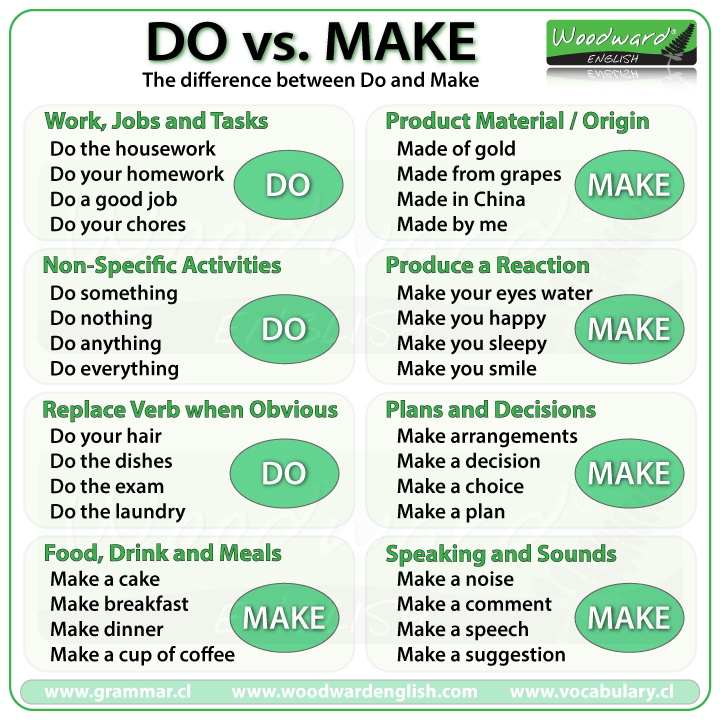
Collocations - DO vs. MAKE (example sentences)


Here are some collocations with do/make used in full sentences.


1. Don’t make excuses! You didn’t do your homework and that’s that!

2. Could you do me a favour and lend me your notebook?

3. I want to make notes while the teacher is explaining.

4. I’ve lost my wallet. What am I going to do?

5. My parents expect me to do things in the house such as making my bed, helping my brothers do the washing up and so on.

6. My father does the ironing and he also makes the best spaghetti sauce in the universe!

7. I didn’t realise they were making fun of me. I suppose I made a fool of myself.

8. If you want to do well in the exam, you’ll just have to make more of an effort.

9. I know I always make a lot of mistakes, but I really am doing my best.

10. Make sure you come to class tomorrow. We’re going to do a test.

11. Take a day off and do nothing for a change. It won’t do you any harm. In fact it will probably do you the world of good.

12. I didn’t want to make a fuss, but I really felt I had to make a formal complaint. They hadn’t done the job properly at all.

13. Doing business with you has been a great pleasure. I’m sure both our companies will make a lot of money out of it.

14. I am afraid that the company has made a massive loss this financial year.

15. Stop making so much noise! I’ve got to make a very important phone call.

Friday, 1 August 2014

Use of English - Rephrasing #003 (CAE)

There is no upper and lower limit in the number of words here. Answers are in white below its respective sentences. Highlight them to be able to read them.

16. ‘But I tried to phone him yesterday,’ said Laura.
admitted
Laura                                                            him the day before.
Laura admitted having tried to contact him the day before.

17. ‘Perhaps I could meet your parents,’ said Steve.
suggested
Steve                                    Laura’s parents.
Steve suggested meeting Laura’s parents.

18. ‘No, I will not speak to him,’ said Laura’s mother.
refused
Laura’s mother                                     Steve.
Laura’s mother refused to speak to Steve.

19. ‘Try being a bit more understanding, Mrs  Carter,’ said the doctor.
encouraged
The doctor                                                      a bit more understanding.
The doctor encouraged Mrs Carter to be a bit more understanding.

20. 'I have made up my mind. I’m going to ask Steve to lunch on Sunday,’ said Laura’s mother.
decided
Laura’s mother                            Steve to lunch on Sunday.
Laura’s mother decided to ask Steve to lunch on Sunday.

21. ‘Would you like to have lunch with us on Sunday, Steve?’ said Laura’s mother.
invited
Laura’s mother                              have lunch with them on Sunday.
Laura’s mother invited Steve to have lunch with them on Sunday.

22. ‘I think you’re right. Laura is too young to stay out so late,’ said Steve.
agreed
Steve                             too young to stay out so late.
Steve agreed she was too young to stay out so late.

23. ‘Next time we could take Andrew with us,’ said Steve.
offered
Steve                             Laura’s younger brother with them the next time.
Steve offered to take Laura’s younger brother with them the next time.

24. ‘Perhaps it would be better to go out in the afternoons,’ said Laura’s father.
recommended
Laura’s father                                              in the afternoons.

Laura’s father recommended going out in the afternoons.

Thursday, 31 July 2014

Use of English - Rephrasing #002 (CAE)

From now on, answers will be in white just below their respective sentence. They are numbered globally through the blog, for precise future reference. There is no upper and lower limit in the number of words here.


9. 'I'm sorry I got home so late,' said Laura. apologised
Laura ............... home so late.
Laura APOLOGISED FOR GETTING home so late.

10. 'I won't tell anyone about it,' said Suzie. promised
Suzie ......................... anyone about it.
Suzie PROMISED NOT TO TELL anyone about it.

11. 'Laura, you should try being honest with your parents,' said the doctor. advised
The doctor ........................ honest with her parents.
ADVISED LAURA TO TRY BEING

12. 'Don't go out with that boy again!' said Laura's father. warned
Laura's father ..................... go out with that boy again.
WARNED HER NOT TO

13. 'You've been meeting your boyfriend after school, haven't you?' said Laura's mother. accused
Laura's mother .............. her boyfriend after school.
ACCUSED HER OF MEETING

14. 'Lend me your gameboy, or I'll tell Mum and Dad,' said Laura's brother. threatened
Laura's brother ........................ her parents unless she lent him her gameboy.
THREATENED TO TELL

15. 'I haven't seen Steve since Saturday night,' said Laura. denied
Laura .................. Steve since Saturday night.
DENIED HAVING SEEN

Tuesday, 29 July 2014

Thesaurus: likely

adjective

  1.  inclineddisposedproneliabletendingapt • People are more likely to accept change if they understand it.
  2.  probableexpectedanticipatedodds-onon the cardsto be expected • A 'yes' vote is the likely outcome.
  3.  plausiblepossiblereasonablecrediblefeasiblebelievableverisimilar • It's likely that he still loves her.
  4.  appropriatepromisingpleasingfitfairfavouritequalifiedsuitableacceptableproperhopeful,agreeableup-and-comingbefitting • He seemed a likely candidate to become Prime Minister.

adverb

  1.  probablyno doubtpresumablyin all probabilitylike enough (informal), doubtlesslylike as not(informal) • Very likely he'd told them of his business interest.
When using likely as an adverb, it is usual to precede it by another, intensifying, adverb such as very or most, for example "it will most likely rain". The use of likely as an adverb without an intensifier, for example "it will likely rain", is considered nonstandard in British English, though it is common in colloquial U.S. English.

from Collins Thesaurus

Monday, 28 July 2014

Use of English – Rephrasing #001 (CAE)

Complete the second sentence so that it has a similar meaning to the first sentence, using the word given. Do not change the word given. You must use between three and six words, including the word given. Answers in blank ink, highlight with your mouse to see them.

1. ‘Where do you think he is?’ she said. WONDERED
She …………………

2. It wasn’t until I finished going out with him that I realized I missed him. BROKE
I realized ……………….that I missed him.

3. I hadn’t seen such a wonderful painting before. NEVER
……………………………. such a wonderful painting.

4. I lost my keys so I was late. IF
I ……………… I hadn’t lost my keys.

5. She was beginning to change her mind about taking the job. SECOND
She was …………….. the job.

6. The problem is not my fault. BLAME
I……………… the problem.

7. The police thought he had been living in Canada. HAVE
He……………. in Canada.

8. His wallet isn’t here so I’m sure it was stolen. MUST
His wallet ……………………….

ANSWERS:
1. She wondered where he was.
2. I realized after I had broken up with him that I missed him.
3. I had never seen such a wonderful painting.
4. I would have arrived on time if I hadn’t lost my keys.
5. She was having second thoughts about the job.
6. I am not to blame for the problem.
7. He was thought to have been living in Canada.
8.His wallet must have been stolen.